EU PPWR 2026: What Every Exporter Needs to Know Before August 12
📋 TL;DR — Key Takeaways
This article covers: paper packaging materials
EU PPWR 2026: The new EU Packaging and Packaging Waste Regulation takes effect August 12, 2026. Complete guide for exporters on hazardous substance limits, recyclability, recycled content, and declaration of conformity requirements.
Best for: packaging buyers and industry professionals
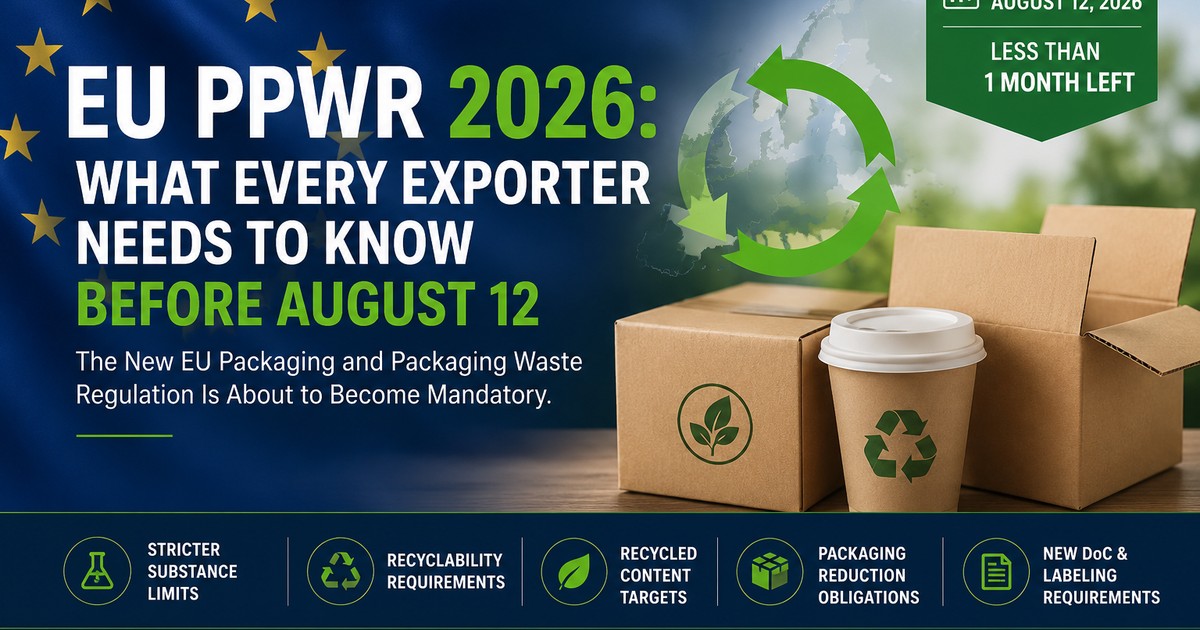
If your products are sold in the European Union, time is running out.
The EU Packaging and Packaging Waste Regulation (PPWR) will become fully applicable on 12 August 2026, leaving businesses with less than one month to ensure compliance.
This is not a routine regulatory update. It represents the largest reform of EU packaging legislation in nearly 30 years. More importantly, PPWR is a Regulation, not a Directive, meaning the same legal requirements apply directly across all 27 EU Member States without national transposition.
For manufacturers, exporters, brand owners, and packaging suppliers, packaging compliance is no longer a supporting task — it is now a prerequisite for market access.
Why PPWR Matters
The new regulation introduces a harmonized legal framework that affects virtually every type of packaging placed on the EU market.
Key changes include:
- A single, directly applicable regulation across all EU Member States
- Packaging compliance becomes a mandatory market-entry requirement
- Stricter controls on hazardous substances
- Mandatory recyclability performance standards
- Minimum recycled content requirements
- Packaging reduction obligations
- New documentation and labeling requirements
1. Restrictions on Hazardous Substances (Effective 12 August 2026)
Packaging must comply with strict limits on heavy metals:
- Lead (Pb)
- Cadmium (Cd)
- Mercury (Hg)
- Hexavalent Chromium (Cr VI)
Combined concentration must not exceed 100 mg/kg.
For food-contact packaging, PPWR also introduces some of the world's strictest limits on PFAS:
- Individual non-polymeric PFAS: <25 ppb
- Total non-polymeric PFAS: <250 ppb
- Total fluorine in polymeric PFAS: ≤50 ppm
2. Mandatory Recyclability Requirements
PPWR establishes recyclability performance classes for all packaging.
From 1 January 2030
All packaging must be classified as:
- Grade A
- Grade B
- Grade C
Packaging with recyclability performance below 70% will no longer be permitted on the EU market.
From 1 January 2038
Only Grade A and Grade B packaging will remain compliant. Grade C packaging will be phased out.
3. Minimum Recycled Plastic Content
PPWR sets mandatory recycled-content targets for plastic packaging.
| Packaging Type | 2030 | 2040 |
|---|---|---|
| PET food-contact packaging | ≥30% | ≥50% |
| Non-PET food-contact packaging | ≥10% | ≥25% |
| Single-use plastic beverage bottles | ≥30% | ≥65% |
| Other plastic packaging | ≥35% | ≥65% |
Certain components containing less than 5% plastic, or where recycled content could create health risks, may qualify for exemptions.
4. Packaging Reduction Requirements
Beginning in 2030, companies must eliminate unnecessary packaging. Examples include:
- No unnecessary layers or decorative empty space
- E-commerce and transport packaging must maintain an empty-space ratio of 50% or less
- Marketing or branding considerations alone will no longer justify oversized packaging
Important Compliance Clarifications
Packaging Definition
Whether an item is considered packaging depends on its function, not simply its appearance. For example:
- Disposable beverage cups are considered packaging
- Medical infusion bags are not
Who Is Responsible?
PPWR distinguishes between different economic operators.
Manufacturer: The entity identified on the packaging is responsible for technical compliance.
Producer: The company that first places the packaged product on the EU market is responsible for Extended Producer Responsibility (EPR) obligations and may need separate registration in each applicable Member State.
Declaration of Conformity (DoC)
From 12 August 2026, packaging must be supported by an EU Declaration of Conformity (DoC). Even exempt packaging categories must retain documentation demonstrating the basis for exemption.
New Labeling Requirements
PPWR introduces harmonized labeling requirements, including manufacturer or importer identification, replacing many existing national labeling practices.
Immediate Actions for Businesses
Companies exporting to the EU should act now:
- Audit all existing packaging formats
- Identify responsibilities across the supply chain
- Evaluate compliance against all four PPWR requirements
- Prepare and sign the required Declaration of Conformity before 12 August 2026
- Establish an ongoing monitoring process for future implementing acts and guidance
Business Risks of Non-Compliance
Failure to comply with PPWR may result in:
- Products being prohibited from entering the EU market
- Mandatory product recalls
- Administrative penalties
- Loss of market access
These obligations apply regardless of whether your company has a legal entity within the European Union. If your packaged products enter the EU market, PPWR requirements apply.
Final Thoughts
PPWR marks a fundamental shift in how packaging is regulated in Europe. Compliance is no longer simply about meeting environmental expectations — it is becoming a core requirement for doing business in the EU.
Companies that begin reviewing their packaging strategies now will be better positioned to minimize compliance risks, protect customer relationships, and maintain uninterrupted access to one of the world's largest markets.
🇪🇺 Preparing for EU PPWR Compliance?
At Salon Paper, we closely monitor global packaging regulations and industry trends. If your business is preparing packaging materials for the European market, our team can support you with compliant paperboard solutions and ongoing regulatory updates.
Contact Our Team →Sourcing PPWR Compliant Packaging Paper?
Salon Paper is a factory-direct supplier in Ningbo, China - cupstock, white cardboard, metallic cardstock and paper cups, with FSC and food-contact options.
Quick Answers
When does EU PPWR become mandatory?
The EU Packaging and Packaging Waste Regulation (PPWR) becomes fully applicable on 12 August 2026.
What are the heavy metal limits under PPWR?
Packaging must comply with a combined concentration limit of 100 mg/kg for lead, cadmium, mercury, and hexavalent chromium.
What are the PFAS limits in food-contact packaging under PPWR?
Individual non-polymeric PFAS must be less than 25 ppb, total non-polymeric PFAS less than 250 ppb, and total fluorine in polymeric PFAS must not exceed 50 ppm.
What are the recyclability requirements under PPWR?
From 2030, all packaging must be classified as Grade A, B, or C with recyclability performance above 70%. From 2038, only Grade A and B will be compliant.
Who is responsible for PPWR compliance?
The manufacturer identified on the packaging is responsible for technical compliance. The producer who first places the packaged product on the EU market is responsible for Extended Producer Responsibility (EPR) obligations.
Is there a grace period for non-compliant packaging under PPWR?
No. Packaging not placed on the EU market before 12 August 2026 must comply immediately. Products already legally placed on the market before that date may continue to be sold.
What is the recycled content target for plastic packaging under PPWR?
PET food-contact packaging needs ≥30% recycled content by 2030 (≥50% by 2040). Non-PET food-contact needs ≥10% by 2030 (≥25% by 2040). Other plastic packaging needs ≥35% by 2030 (≥65% by 2040).