This article covers: EU PPWR (Regulation (EU) 2025/40) compliance for paper packaging
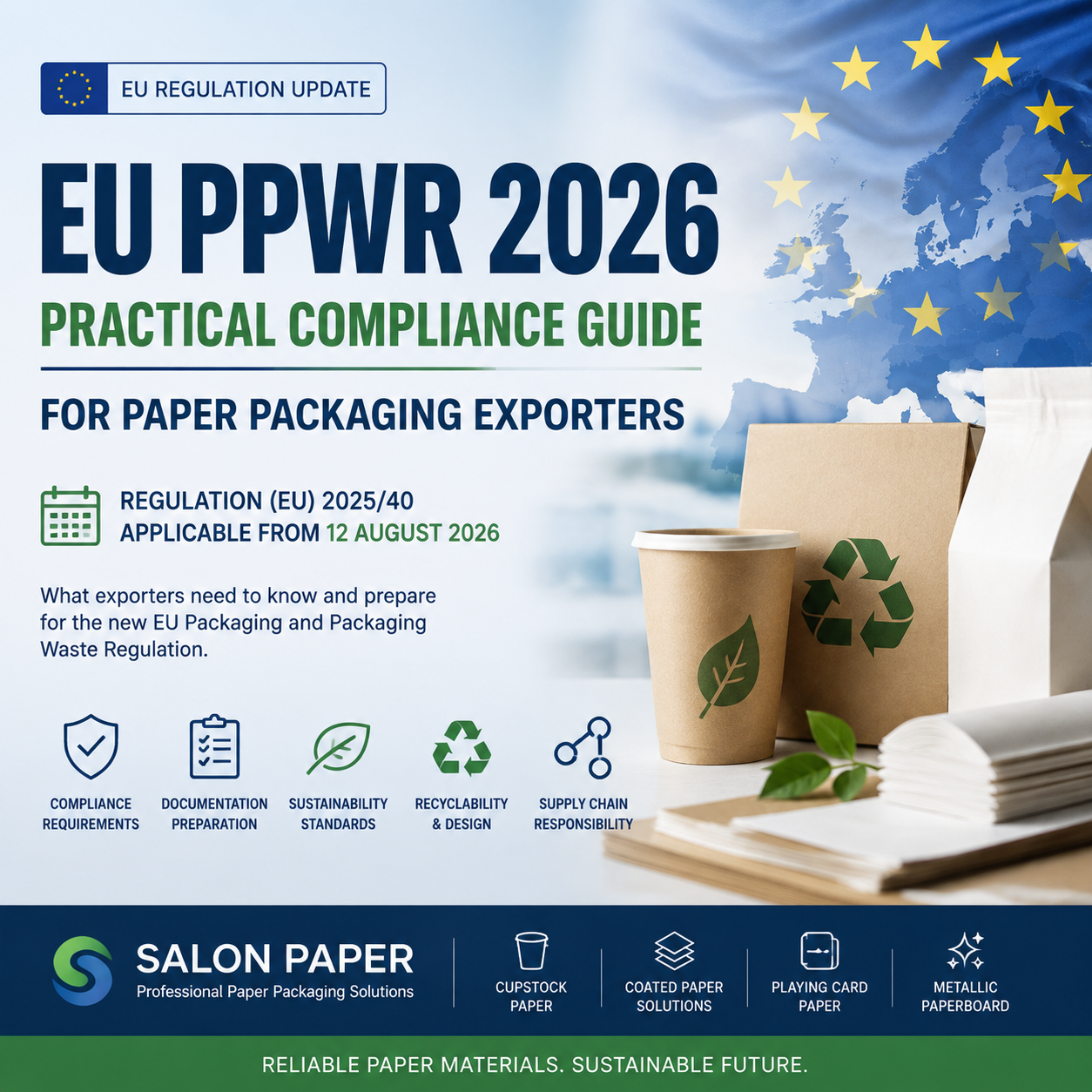
The EU Packaging and Packaging Waste Regulation becomes applicable from 12 August 2026. Exporters must move from providing test reports to building a complete compliance system linking material, structure, testing, documentation and responsibility.
Best for: paper packaging exporters, cupstock suppliers, barrier coated paper producers and packaging converters selling to the EU
Practical steps to prepare for the EU Packaging & Packaging Waste Regulation
The EU packaging industry is entering a new compliance era. With the Packaging and Packaging Waste Regulation (PPWR, Regulation (EU) 2025/40) becoming applicable from 12 August 2026, companies exporting paper-based packaging products to Europe need to prepare beyond traditional quality reports.
A key question for exporters is: Are we only providing test reports, or are we building a complete compliance system?
PPWR compliance is not a single certificate. It requires a complete connection between:
Many companies focus only on the base paper. However, modern paper packaging usually contains multiple components:
For example, a food paper cup is not only paper. Its compliance may depend on:
A supplier material report can support compliance evaluation, but it does not automatically represent the compliance of the final packaging.
Under PPWR, companies need to pay attention to several key areas.
Packaging materials need to control restricted substances such as:
The focus is not simply obtaining a report, but ensuring that the tested sample represents the actual packaging structure.
For food-contact packaging, PFAS restrictions introduce additional challenges. Companies need to understand:
A “pass” result is meaningful only when the testing scope and method are clearly defined.
Water-based coatings are becoming increasingly important in paper packaging applications. However, water-based does not automatically mean compliant.
It does not automatically represent:
A coating solution needs evaluation from:
The future competition will not only be about choosing sustainable materials, but choosing the right materials for the right application.
For paper packaging suppliers, the future challenge is creating traceable documentation. A practical compliance system should include:
The goal is not collecting more certificates. The goal is making sure every document can answer:
For companies supplying the EU market:
Example: Paper + coating + ink + adhesive + final conversion process.
Confirm: material composition, compliance statements, test scope, and version control.
Different products require different focus:
Material changes, coating changes, and process changes may require compliance reassessment.
The future of paper packaging is moving from price competition to compliance & value competition. Global customers are looking for suppliers who can provide not only materials, but also:
At Salon Paper, we continue monitoring global packaging regulations and developing professional paper packaging solutions for international markets. Our solutions include:
Talk to our team about cupstock, barrier coated paper, metallized board and compliance documentation for EU export.
Request a Quote