Este artículo cubre: recubrimientos de barrera y envases de papel sostenibles
Comprenda las diferencias entre el recubrimiento de base acuosa, el recubrimiento de PHA, el PE y el PLA. Aprenda qué significa realmente "sin plástico" y cómo funcionan los recubrimientos de barrera en los envases de papel sostenibles.
Ideal para: ingenieros de empaque y responsables de sostenibilidad
Comprensión de los recubrimientos de base acuosa, el PHA y la verdad sobre los envases de papel sin plástico
Bienvenido a la Enciclopedia de Materiales de Envase, una serie de conocimiento técnico creada por Salon Paper. Nuestra misión es ayudar a los compradores de envases, transformadores, propietarios de marcas y fabricantes a comprender mejor los materiales de envase de papel, las tecnologías de recubrimiento de barrera y las tendencias emergentes de sostenibilidad. Cada episodio se centra en un material o tecnología de envase esencial, proporcionando información práctica para apoyar una mejor selección de materiales y decisiones de envasado.
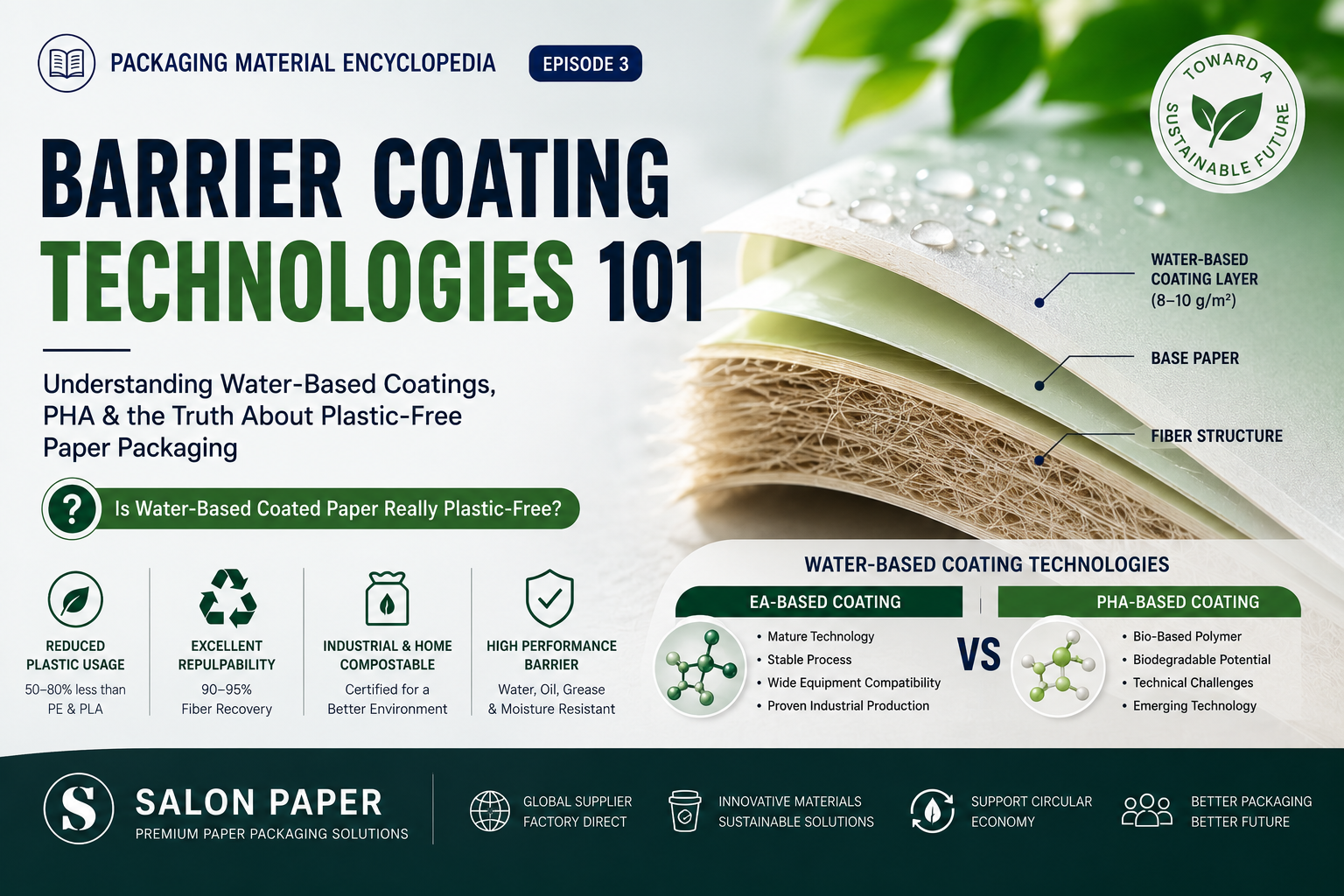
A medida que los gobiernos de todo el mundo introducen regulaciones más estrictas sobre los plásticos de un solo uso, las tecnologías de recubrimiento de barrera se han convertido en una de las innovaciones de más rápido crecimiento en el empaque de papel.
Hoy en día, términos como Plastic-Free, Water-Based Coating, PHA Coating, Compostable, and Repulpables se utilizan ampliamente en toda la industria.
Sin embargo, estos términos a menudo se malinterpretan e incluso a veces se confunden entre sí.
Una de las preguntas más comunes que escuchamos es:
¿Es el PHA lo mismo que un recubrimiento de base acuosa?
La respuesta es No.
Comprender esta distinción es esencial para los compradores de empaques, convertidores y propietarios de marcas que evalúan soluciones de empaque sostenibles.
Antes de analizar materiales individuales, es importante comprender el concepto más amplio.
A Recubrimiento de Barrera es una capa funcional aplicada al cartón para mejorar la resistencia contra:
Sin un recubrimiento de barrera, el papel por sí solo no puede contener de forma segura muchos productos alimenticios y de bebidas.
Hoy en día, las tecnologías de recubrimiento de barrera más comunes incluyen:
Esto significa que El recubrimiento a base de agua es una plataforma tecnológica—no un solo material.
Este es quizás el mayor concepto erróneo en el mercado actual de empaques sostenibles.
El PHA en sí mismo no es un recubrimiento de base acuosa.
PHA es un bio-based polymer.
Se puede formular en un dispersión base agua y luego se aplica como parte de un sistema de recubrimiento base agua.
En otras palabras:
Recubrimiento de barrera ├── PE ├── PLA └── Recubrimiento a base de agua ├── Acrílico ├── EAA ├── PVOH ├── Dispersión de poliolefina └── Dispersión de PHA
Por lo tanto, El PHA es una posible materia prima utilizada en ciertos sistemas de recubrimiento a base de agua; no es sinónimo de recubrimiento a base de agua en sí.
Esta distinción es particularmente importante al hablar de afirmaciones ambientales.
Otro malentendido común se refiere al término Plastic-Free.
Si un papel con recubrimiento de base acuosa puede describirse legalmente como sin plástico depende de las regulaciones aplicables.
Según la Directiva sobre Plásticos de un Solo Uso (SUPD), los materiales producidos mediante polimerización artificial—incluidos acrílicos, EAA y muchas dispersiones sintéticas—pueden aún entrar dentro de la definición de plástico.
Por lo tanto, muchos papeles recubiertos a base de agua disponibles comercialmente no pueden describirse automáticamente como libres de plástico, aunque contienen significativamente menos polímero que el papel recubierto con PE convencional.
Por esta razón, las marcas deben ser cautelosas al hacer afirmaciones de marketing de “libre de plástico”.
Aunque muchos recubrimientos a base de agua todavía contienen polímeros sintéticos, ofrecen varias ventajas ambientales significativas.
Un recubrimiento de PE convencional suele requerir alrededor de 18–25 g/m² of polymer.
Muchos sistemas de recubrimiento a base de agua logran un rendimiento de barrera comparable con solo:
8–10 g/m²
Esto significa:
Menos recubrimiento significa menor consumo de material y menor huella de carbono.
Una de las mayores fortalezas de la tecnología de recubrimiento a base de agua es el reciclaje del papel.
Muchos productos alcanzan:
90–95% de capacidad de repulpado
Durante el reciclaje, el recubrimiento se dispersa más fácilmente que las películas laminadas tradicionales, lo que permite recuperar eficientemente las valiosas fibras de papel.
Esto mejora enormemente el rendimiento del reciclaje.
Algunos sistemas de recubrimiento avanzados han obtenido con éxito ambas:
Estas certificaciones requieren pruebas de:
A diferencia de los plásticos convencionales que simplemente se fragmentan en microplásticos, los recubrimientos biodegradables certificados están diseñados para descomponerse en sustancias naturales bajo condiciones de compostaje adecuadas.
El mercado actual de recubrimientos a base de agua está impulsado principalmente por dos enfoques tecnológicos.
Actualmente, la solución comercial más madura.
Las ventajas incluyen:
Para la mayoría de los vasos de papel comerciales y envases de alimentos actuales, los recubrimientos a base de EA siguen siendo la opción dominante.
El PHA representa una de las tecnologías a largo plazo más prometedoras de la industria.
Sus ventajas incluyen:
Sin embargo, la comercialización sigue siendo un desafío.
Las principales barreras técnicas incluyen:
Como resultado, el PHA todavía se considera una tecnología emergente en lugar de una solución comercial totalmente madura.
| Característica | Recubrimiento a base de EA | |
|---|---|---|
| Madurez | Altamente madura | |
| Cadena de suministro | Estable & confiable | |
| Proceso de recubrimiento | Equipo estándar | |
| Rendimiento de barrera | Excelente | |
| Biodegradabilidad | Limitada | |
| Costo | Competitivo |
Es poco probable que el futuro del envasado sostenible se defina por un único material.
En cambio, las soluciones exitosas combinarán:
En lugar de preguntar si un material es “mejor”, los compradores de envases deberían evaluar qué tecnología de recubrimiento se adapta mejor a sus productos, procesos de producción y objetivos de sostenibilidad.
At Salon Paper, creemos que el envase sostenible no se trata de seguir tendencias ni de depender de palabras de moda del marketing.
Se trata de comprender la ciencia detrás de los materiales y seleccionar soluciones que ofrezcan el equilibrio adecuado de performance, recyclability, and environmental responsibility.
A medida que las tecnologías de recubrimiento de barrera continúan evolucionando, seguimos comprometidos a ayudar a nuestros clientes a tomar decisiones informadas sobre materiales para la próxima generación de envases de papel.
No. PHA es un polímero de base biológica que puede utilizarse como uno de los componentes en ciertos sistemas de recubrimiento base agua.
No necesariamente. Depende de la química del recubrimiento y de la definición regulatoria aplicable de plástico. Según la SUPD de la UE, muchos recubrimientos a base de agua aún pueden contener materiales clasificados como plástico.
Porque generalmente utilizan mucho menos material de recubrimiento (50–60% menos que PE), ofrecen una excelente repulpabilidad (90–95%) y algunas formulaciones pueden obtener certificaciones de compostabilidad industrial o doméstica.
Los recubrimientos a base de agua con base EA son actualmente los más maduros comercialmente. Los sistemas a base de PHA tienen un potencial significativo a largo plazo, pero aún enfrentan desafíos técnicos antes de su comercialización generalizada.
¿Busca asesoramiento experto sobre materiales de recubrimiento de barrera para su envase de papel?
Ya sea que necesite cartón recubierto con PE, soluciones de recubrimiento a base de agua, o quiera explorar opciones a base de PHA para proyectos futuros, Salon Paper está aquí para ayudarle.
📩 Contáctenos hoy para hablar de su proyecto.
Ningbo Salon Paper Product Co., Ltd.
📧 [email protected] | 🌐 www.salonpaper.com
Una Serie de Conocimiento de Salon Paper - Continúe aprendiendo con la serie completa: