A 2026 outlook on the global pulp and paper industry: pulp and recovered-paper supply, capacity expansion in China and Southeast Asia, price pressure in North America and Europe, and what packaging buyers should prepare for.
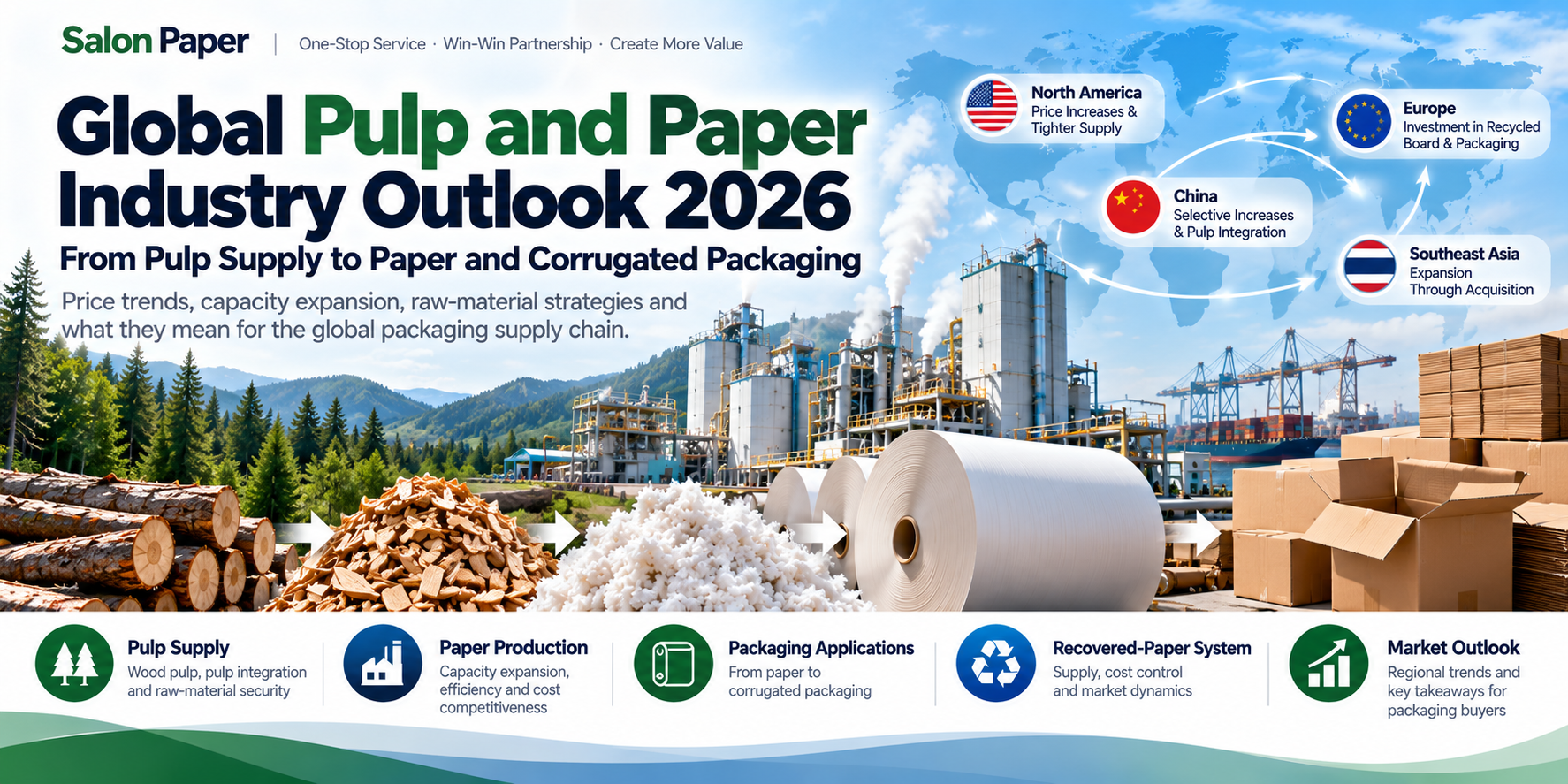
From pulp supply to corrugated packaging — the forces that will shape paper and board markets in 2026.
Paper markets spent the last few years reacting to demand shocks. 2026 looks different: the decisive variables are on the supply side — pulp availability, recovered-paper quality, energy cost and the pace of capacity expansion. For packaging buyers, that changes the question from "how cheap is board?" to "can my supplier deliver a consistent grade, on time, all year?"
This outlook walks through the five forces that shape 2026, the regional picture, and the practical checklist we use when customers ask us to quote for the following twelve months.
1. Pulp supply and raw-material security. Producers with their own pulp, or with long-term pulp contracts, control cost and quality. Those without it buy on the open market at whatever the quarter brings.
2. Energy and conversion cost. Papermaking and coating are energy-intensive. Where energy is expensive, mills run more selective grades and shut marginal machines earlier.
3. Recovered paper — availability and quality. Recycling rates are high, but the quality of the recovered fibre stream is uneven. That directly affects recycled board strength, printability and food-contact compliance.
4. Regulation and specification. Europe's packaging and deforestation rules are pushing brand owners to ask for documented fibre origin, recyclability data and lower coating weights.
5. Trade flows and logistics. Freight rates, container availability and tariff changes decide whether a container of board from Asia is competitive against a local mill for a given quarter.
Pulp is the single biggest cost lever in the chain. Two things are happening at the same time: large producers are integrating pulp into their own paper and packaging operations, and smaller converters are being squeezed on spot pulp.
For buyers of coated and laminated board this matters indirectly but strongly. When pulp is tight, every downstream grade — cupstock, white board, kraft, containerboard — tightens together, and allocation replaces negotiation.
New capacity is not evenly distributed. Most of it is in Asia, and it is increasingly large and efficient. In mature markets, the response is the opposite: consolidation, grade rationalisation and the closure of older machines.
Practically: expect tighter supply and firmer pricing in North America and parts of Europe, and competitive, well-supplied export pricing out of China and Southeast Asia.
Announced increases on pulp, containerboard and board grades, combined with limited new capacity, mean buyers should expect firmer quotes and less room for last-minute specification changes.
European mills are investing where regulation and brand demand point: recycled containerboard, food-grade recycled board and lighter packaging. At the same time, energy costs and compliance documentation raise the floor price. Buyers increasingly need suppliers who can evidence fibre origin and recyclability.
Chinese producers are adding capacity selectively, not uniformly, and are integrating pulp and recovered fibre supply to stabilise cost. For export buyers, China remains the most flexible source for coated, laminated and metallised grades — provided you choose a supplier that controls its own coating and converting lines.
Growth in the region is increasingly acquisitive: buying existing mills and converting them to packaging grades is faster than building. Capacity is rising, but so is the spread between best-in-class and average quality — sampling before ordering matters more than ever.
Recovered fibre is no longer a cheap substitute; it is a strategic input. Collecting, sorting and de-inking capacity decides what qualities are actually available, and cross-border restrictions on recovered-paper imports changed trade flows permanently after 2021.
For packaging buyers, the consequence is simple: recycled content claims must be backed by test data, and the strength of a recycled board is only as good as the sorting behind it.
Demand is shifting inside the chain. E-commerce and food delivery keep corrugated and food-service packaging busy, while premium segments — cosmetics, spirits, confectionery, electronics — keep asking for coated, metallised and holographic surfaces that print well and survive shipping.
We do not speculate on pulp markets — we control what we can: coating, laminating and metallising on our own lines in Ningbo, China. That means stable specifications for gold and silver metallised cardstock, holographic board, aluminium foil laminated paper, cupstock and food-grade coated board, with PE, PLA and water-based barrier options (acrylic, EAA, PHA).
If you are planning 2026 volumes, send us your specification — grade, grammage, size and coating — and we will quote FOB Ningbo with samples you can test on your own line.
Directionally, supply-led markets point to firmer pricing in North America and parts of Europe, while Asian export pricing stays competitive. The decisive factors are pulp availability, energy cost and freight — not demand alone.
Because it determines strength, printability and food-contact compliance of recycled board. Poorly sorted fibre is the most common cause of inconsistent board performance.
It depends on your barrier requirement, heat exposure and the regulations you sell into. PE remains the cheapest barrier; water-based coatings (acrylic, EAA, PHA) and PLA reduce plastic content and can support recyclability claims — but each needs testing against your actual product.
Yes. In a supply-led market, a qualified second source is inexpensive insurance — and it gives you real leverage in negotiations.
Yes. We send free A4 samples so you can check surface, printability and stiffness on your own equipment before committing to a volume order.
Editorial note: this outlook summarises publicly reported industry trends and our own experience as a converter in Ningbo, China. It is directional rather than a statistical forecast — always verify current prices and availability with your supplier before making purchasing decisions.
Salon Paper is a factory-direct converter in Ningbo, China — gold and silver metallised cardstock, holographic board, aluminium foil laminated paper, cupstock and food-grade coated board.
📩 Send us your grade, grammage, size and coating requirement and we will come back with samples and a factory-direct quote.
Ningbo Salon Paper Product Co., Ltd.
📧 [email protected] | 🌐 www.salonpaper.com
Salon Paper supplies paper and board direct from our own coating, laminating and metallising lines in Ningbo: metallic cardstock, holographic board, foil laminated paper, cupstock, food-grade coated board and paper cups.