PHA (polyhydroxyalkanoate) is a bio-based polyester that can be applied to paper cups as a water-based barrier coating instead of PE extrusion coating.
Supplier-reported figures (specified test conditions): coat weight 8–10 g/m² for PHA water-based coating vs 20–25 g/m² for typical commercial extrusion coating; line output +80%; average production time −30%; raw material to finished cup in about 100 days.
Certified: four TÜV AUSTRIA certificates — OK compost HOME, OK biodegradable SOIL, WATER and MARINE — for the certified PHA raw-material grades.
Best for: paper cup converters, brand owners and packaging buyers evaluating a lower-coat-weight, bio-based alternative to PE.
From material to real cups — a practical path to more sustainable packaging
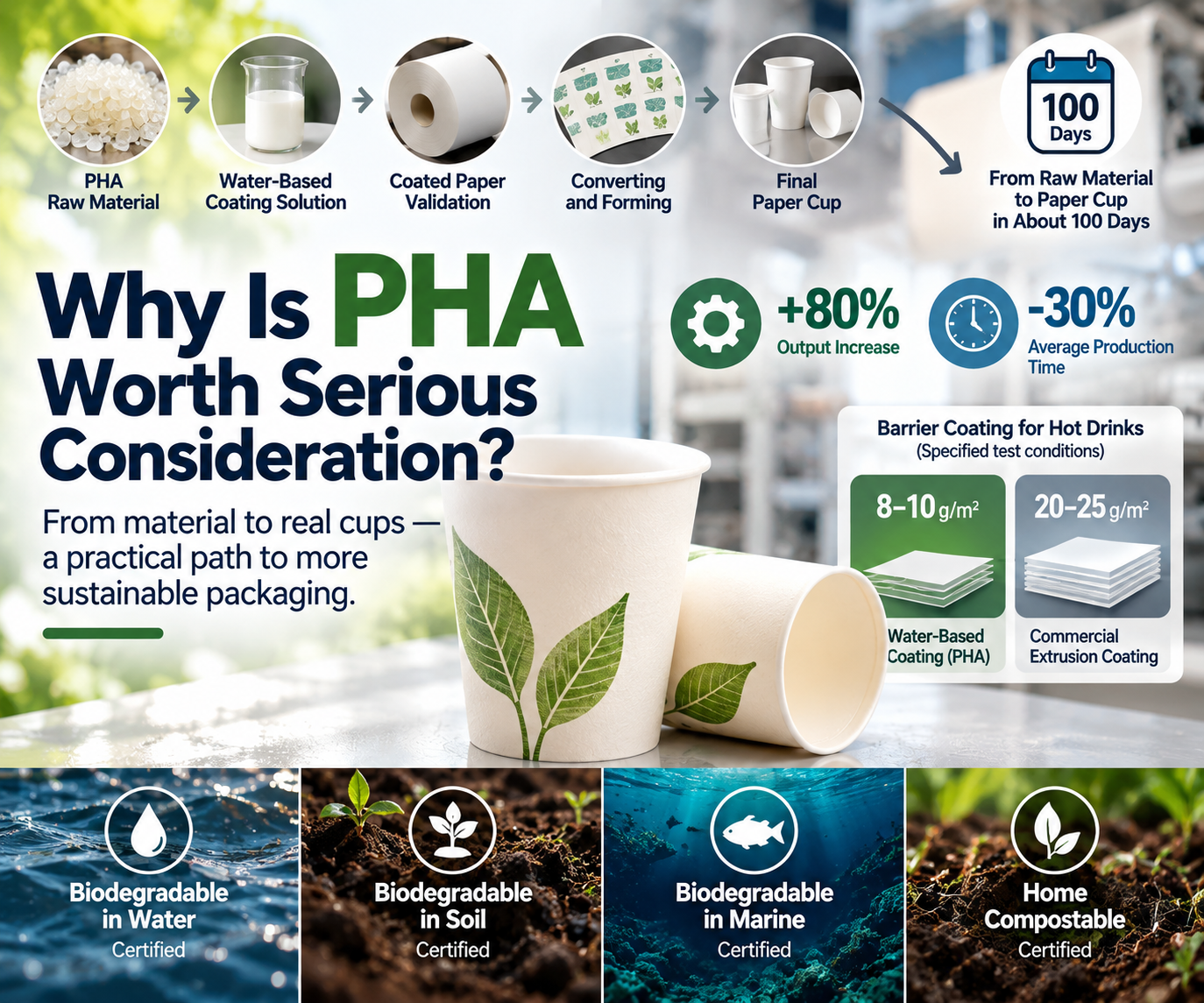
PHA water-based barrier coating — from raw material to a finished paper cup, and the four biodegradation certificates behind it. Supplier data under specified test conditions.
Most paper cups sold today are still made with a thin PE (polyethylene) extrusion coating. It is cheap, it works, and the converting industry knows exactly how to handle it. The problem is not performance — it is the end of life: a PE-coated cup is a plastic-and-paper composite that most recycling systems cannot separate economically.
Water-based barrier coatings were the first answer to that problem. Instead of extruding a plastic film onto the board, you apply a water-based coating and dry it — using the same presses and the same downstream converting equipment you already have.
PHA takes that idea one step further. It is not just a coating that avoids plastic film — it is a coating built on a bio-based, biodegradable polymer that carries third-party biodegradation certificates across four different environments.
This guide walks through what PHA water-based coating actually is, the five-step production path from resin to finished cup, what the coating-weight numbers mean on a real line, and which claims on a supplier datasheet you should verify before you switch. If you are still comparing coating families first, start with Barrier Coating Technologies 101 and PLA vs. PHA Coating.
PHA (polyhydroxyalkanoate) is a family of bio-based polyesters produced by microbial fermentation — bacteria accumulate the polymer as an energy reserve, and it is then extracted and processed into resin or granulate.
To turn that resin into a coating, it is dispersed in water to form a coating solution. That is the key difference from extrusion coating: you are not melting a plastic film and pressing it onto the board. You are applying a liquid dispersion with a coating head or a printing unit and then drying it, exactly like the aqueous barrier coatings already used for cold cups and food trays.
The result is a very thin barrier film that:
The infographic at the top of this page compresses the whole supply chain into five steps. Each one is a real decision point when you are sourcing PHA-coated cupstock or converting PHA-coated cups in-house.
Everything starts with the certified PHA grade — resin or granulate — produced by fermentation. This is the material that the biodegradation certificates are issued against, so the grade and trade mark matter: they are what make the downstream claims traceable.
The resin is formulated into a water-based dispersion. Formulation is where the performance happens — solids content, additives, adhesion promoters and the handling behaviour of the dispersion all determine whether the coating can run at the coat weight you need.
Before a single cup is formed, the coating has to be validated on the actual base paper or board. Two boards with the same GSM can behave very differently: surface absorption, smoothness and fibre composition all change how much dispersion the sheet takes up and how even the film is.
The coated reel or sheet goes through the normal converting chain — printing, die-cutting, cup forming, bottom sealing. This is where a water-based coating proves its value commercially, because it is designed to run on existing aqueous-coating and cup-forming equipment rather than requiring a new extrusion line.
The finished cup then goes through the same food-contact, leak and hot-liquid checks as any other cup. The supplier figure quoted for the whole chain — from raw material to finished paper cup in about 100 days — is a project timeline: formulation, validation, trial runs and approvals, not the time to physically coat paper.
The single most useful number on a coating datasheet is the coat weight, because it drives material cost, repulpability and the barrier you can actually achieve.
| Coating | Indicative coat weight | What it means in practice |
|---|---|---|
| Water-based coating (PHA) | 8–10 g/m² | Less coating material per cup, applied from water, dried rather than extruded |
| Commercial extrusion coating | 20–25 g/m² | A continuous plastic film, roughly 2–3× the coating weight |
Figures as presented for hot-drink cups under specified test conditions. Coat weight is board-, machine- and formulation-specific — treat these as a starting range to validate, not as a guaranteed minimum on your line.
A lower coat weight is not automatically better. The reason it matters is that barrier performance has to survive the forming operation and the hot liquid inside the cup. What you are really looking for is the lowest coat weight that still passes your leak, seam and hot-liquid tests. That number is the one worth quoting in a commercial agreement.
Throughput claims on coating datasheets come from a specific line, a specific board and a specific coating weight. The useful way to read them is as a direction of travel:
Both numbers need to be re-measured on your equipment before they enter a business case. What is genuinely structural is that a water-based coating process removes the extrusion step — that is where the speed and flexibility come from.
This is where PHA separates itself from most bio-based coating stories. Four TÜV AUSTRIA certificates cover degradation in four different environments:
| Certificate | Environment |
|---|---|
| OK compost HOME | Home composting |
| OK biodegradable SOIL | Soil |
| OK biodegradable WATER | Fresh water |
| OK biodegradable MARINE | Seawater |
Two details decide whether those certificates mean anything for your product:
You can review the certificate numbers, the certification body, the certified trade marks, the validity periods and the certified thickness limits here: PHA Biodegradation Certificates (TÜV AUSTRIA). We keep that page updated with the documents themselves so buyers can check the source rather than take a claim on trust.
| Coating | Typical use today | Watch out for |
|---|---|---|
| PE extrusion | The default for hot cups worldwide | Not recyclable in most systems; visible plastic film |
| Water-based acrylic / barrier dispersion | Cold cups, food trays, grease barriers | Heat and liquid performance must be tested per application |
| PLA coating | Commercially mature bio-based option | Needs industrial composting conditions; heat limits on standard grades |
| PHA water-based coating | Hot-drink cups and premium sustainability projects | Availability, price premium, must validate coat weight on your board |
For a deeper comparison of the two bio-based options, see PLA vs. PHA Coating; for the PE side of the story, see PLA vs. PE Coating Guide 2026. If your question is really about the board underneath the coating, Paper Cup Material Guide and Paper Cup Board 101 cover cupstock selection in detail.
The PHA story is not “one material replaces PE everywhere”. It is a specific, useful tool: a water-based coating that can be applied at roughly one third to one half of a typical extrusion coat weight, on equipment converters already own, from a raw material with biodegradation certificates in four environments.
That combination is what makes it worth serious consideration for hot-drink cups and for brand owners whose packaging claims are being audited. The commercial question is not whether the technology works — it is whether the coat weight, the food-contact documentation and the cost per thousand cups line up for your specific program.
Salon Paper supplies cupstock, coated board and finished paper cups from our factory in Ningbo, including barrier-coated paper and PE / water-based / PLA coating options. If you are evaluating PHA for a new program, we can supply board and cups for your own trial and put you in touch with the material documentation you need.
PHA (polyhydroxyalkanoate) is a bio-based polyester produced by microbial fermentation. In a water-based barrier coating it is dispersed in water and applied to paper or board like a conventional aqueous coating, then dried to form a thin barrier film that resists water, grease and, depending on the grade, hot liquids.
Food-contact compliance depends on the specific formulation, the coating weight and the market you sell into. PHA is generally regarded as a food-contact-suitable material, but every project still needs the coating supplier’s food-contact statement and, where required, migration testing for the finished article under the rules of the destination market.
Supplier data for hot-drink cups shows a water-based PHA coating applied at roughly 8–10 g/m², compared with about 20–25 g/m² for a typical commercial extrusion coating under the same specified test conditions. Lower coat weight means less material on the cup, but the achievable minimum always has to be validated on your own board and cup-forming line.
Because the coating is applied at a low weight and is not a plastic film, repulpability testing is usually more favourable than for PE extrusion coating. Always ask for repulpability or recyclability test data for the exact coating weight you plan to use rather than relying on a general statement.
The certificates cover the certified PHA raw-material grades (resin or granulate) supplied under specific trade marks, and they are thickness-specific. Home compostability is certified up to 0.985 mm nominal film thickness and marine biodegradation up to 0.25 mm. You can review the certificate numbers, validity dates and trade marks on our PHA biodegradation certificate page.
PHA water-based coatings are being used on hot-drink cups, which is exactly where the low coat weight matters most. Performance for a given temperature and dwell time must be confirmed with a hot-liquid test on the finished cup, so treat any supplier figure as a starting point for your own trial.
At Salon Paper we supply cupstock, barrier-coated board and finished paper cups — with PE, water-based and PLA coating options, and the documentation your market requires.
📩 Send us your cup size, GSM and coating requirement and we will come back with samples and a factory-direct quote.
Ningbo Salon Paper Product Co., Ltd.
📧 [email protected] | 🌐 www.salonpaper.com
Salon Paper is a factory-direct supplier in Ningbo, China - cupstock, white cardboard, metallic cardstock and paper cups, with FSC and food-contact options.