This article covers: barrier coatings and sustainable paper packaging
PLA vs PHA Coating: Which bio-based barrier solution is right for sustainable paper packaging? Compare differences in cost, performance, compostability, and applications in this expert guide from Salon Paper.
Best for: packaging engineers and sustainability managers
Which Bio-Based Barrier Solution Is Right for Sustainable Paper Packaging?
Welcome to the Packaging Material Encyclopedia, a technical knowledge series created by Salon Paper. Our mission is to help packaging buyers, converters, brand owners, and manufacturers better understand paper packaging materials, barrier coating technologies, and emerging sustainability trends. Each episode focuses on one essential packaging material or technology, providing practical insights to support better material selection and packaging decisions.
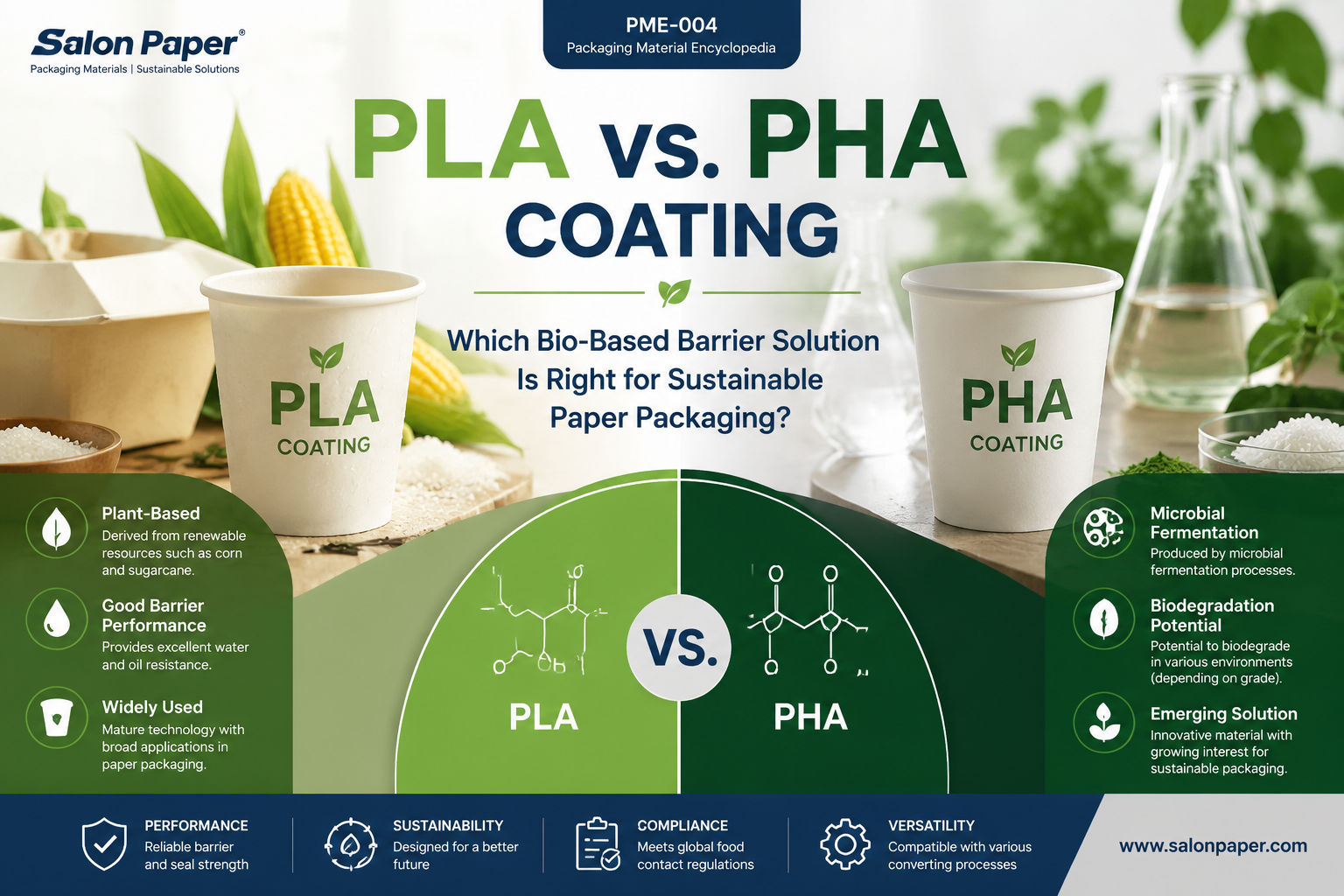
As sustainability continues to reshape the packaging industry, bio-based barrier materials have become a key focus for brand owners, converters, and packaging manufacturers.
Among the many available options, PLA (Polylactic Acid) and PHA (Polyhydroxyalkanoates) are two of the most frequently discussed materials for paper packaging applications.
Questions such as "What is the difference between PLA and PHA?", "Which material is more sustainable?", or "Will PHA replace PLA in the future?" are becoming increasingly common.
The answer, however, is not as straightforward as it may seem.
Although both PLA and PHA are bio-based polymers with biodegradation potential, they differ significantly in manufacturing methods, commercial maturity, barrier performance, processing characteristics, regulatory considerations, and cost.
For packaging manufacturers, selecting between PLA and PHA is not about choosing the "most advanced" material. It is about identifying the solution that best matches product performance requirements, target markets, regulatory expectations, and overall production costs.
This article provides a practical comparison of PLA and PHA coatings from the perspective of packaging engineering and commercial applications.
PLA (Polylactic Acid) is a bio-based polymer produced from renewable agricultural resources such as corn starch or sugarcane. Through fermentation, plant sugars are converted into lactic acid, which is then polymerized to produce PLA resin.
Today, PLA is one of the most commercially established bio-based materials available for packaging applications. Thanks to its mature supply chain and relatively stable production capacity, it has become a widely adopted alternative to conventional petroleum-based coatings.
For paper packaging, PLA is typically applied using extrusion coating technology, forming a continuous barrier layer that provides water resistance, grease resistance, and heat-sealing capability. Typical applications include paper cups, food containers, bowls, takeaway packaging, and disposable food-service products.
Compared with conventional PE coating, PLA offers the advantage of being produced from renewable resources. Under appropriate industrial composting conditions, PLA also demonstrates good biodegradation potential, making it attractive for brands seeking more sustainable packaging solutions.
However, it is important to understand that PLA is not designed to biodegrade rapidly in every environment.
Current industry understanding indicates that PLA requires controlled industrial composting conditions—including elevated temperature, humidity, and microbial activity—to decompose efficiently. In landfills, soil, or marine environments, degradation is generally much slower.
For this reason, describing PLA simply as "naturally biodegradable" may be misleading without additional context.
Another consideration is heat resistance. Standard PLA formulations may not be suitable for high-temperature food packaging unless modified or combined with other materials to improve thermal performance.
PHA (Polyhydroxyalkanoates) refers to a family of bio-based polymers naturally produced by microorganisms through fermentation.
Unlike PLA, PHA is not a single material but rather a group of polymers with different physical and chemical characteristics. As a result, performance can vary considerably depending on the specific formulation.
In recent years, PHA has attracted growing attention as one of the promising next-generation bio-based materials for sustainable packaging.
Compared with PLA, certain PHA grades may offer improved flexibility and demonstrate biodegradation potential under a broader range of environmental conditions. These characteristics have generated considerable interest in research and commercial development.
However, PHA also faces several practical challenges.
Commercial production volumes remain significantly smaller than those of PLA, resulting in higher material costs and a less mature global supply chain. Consequently, PHA is currently more common in premium packaging applications and innovation-driven projects than in large-scale commodity packaging.
Although market adoption continues to grow, PHA is still considered an emerging material rather than a fully established replacement for PLA.
| Property | PLA | PHA |
|---|---|---|
| Raw Material Source | Plant-based sugars and starches | Microbial fermentation |
| Commercial Maturity | High | Developing |
| Supply Availability | Stable | More limited |
| Cost | Lower | Higher |
| Water Resistance | Good | Good |
| Grease Resistance | Good | Good |
| Heat Seal Performance | Good | Depends on formulation |
| Industrial Compostability | Mature | Promising |
| Biodegradation Potential | Mainly industrial composting | Varies by grade and environment |
| Typical Applications | paper cups, food containers, takeaway packaging | Premium sustainable packaging, innovation projects |
There is no universally "better" material between PLA and PHA.
If your business prioritizes cost efficiency, production stability, and large-scale commercial manufacturing, PLA remains one of the most practical bio-based coating solutions currently available.
If your company is developing premium sustainable packaging or exploring next-generation bio-based materials, PHA deserves close attention despite its higher cost and relatively limited availability.
It is also important to recognize that the future of paper packaging is unlikely to be dominated by a single coating technology.
Conventional PE coatings, water-based barrier coatings, PLA, PHA, and other emerging barrier technologies are all expected to coexist, each serving different applications, performance requirements, and regional markets.
Selecting the right material should therefore be based on packaging performance, regulatory compliance, end-of-life management, customer expectations, and total production cost—not simply on whether a material is labeled as "biodegradable."
Do not assume that all bio-based materials perform the same way.
Although PLA and PHA are both bio-based polymers, they differ significantly in processing technology, barrier performance, commercial maturity, certification requirements, and end-of-life management.
For packaging manufacturers, selecting a coating material should always be based on the intended application, target market, available waste management infrastructure, and overall product lifecycle rather than relying on a single sustainability claim.
Sustainable packaging is no longer about finding one material that replaces all others. Instead, it is about selecting the most appropriate solution for each application.
PLA currently offers a mature and commercially proven pathway for many paper packaging products, while PHA continues to evolve as a promising material for future innovation.
As regulations, recycling systems, and bio-based technologies continue to develop, packaging decisions will increasingly depend on balancing performance, compliance, environmental impact, and commercial feasibility.
Understanding these trade-offs is the first step toward building truly sustainable paper packaging solutions.
PLA (Polylactic Acid) is a plant-based polymer produced from corn or sugarcane through fermentation and polymerization. It is commercially mature, cost-effective, and biodegrades under industrial composting conditions. PHA (Polyhydroxyalkanoates) is produced by microbial fermentation and offers biodegradation potential across a broader range of environments, but has higher cost and less commercial availability.
Both are bio-based. PLA is well-established with a mature recycling infrastructure for industrial composting. PHA has broader biodegradation potential but is still emerging commercially. The choice depends on specific application requirements, waste management infrastructure, and sustainability goals.
Not in the near future. PLA is currently far more commercially established with stable supply chains and lower costs. PHA is gaining attention as a next-generation material but remains more suitable for premium, innovation-driven packaging applications. Both materials are expected to coexist alongside PE and water-based coatings.
Standard PLA has limited heat resistance and may not be suitable for high-temperature applications without modification. PHA performance varies by formulation. For hot beverage cups, modified PLA blends or PE-based coatings remain more common in commercial production.
PLA requires controlled industrial composting conditions elevated temperature, humidity, and microbial activity to biodegrade efficiently. In landfills, soil, or marine environments, degradation is significantly slower. Describing PLA as "naturally biodegradable" may be misleading without proper context.
At Salon Paper, we supply premium paper packaging materials with PE, Water-Based, and PLA coating options.
Whether you are evaluating PLA for standard production or exploring PHA for next-generation projects, our team can help you select the right material.
📩 Contact us today to discuss your packaging requirements.
Ningbo Salon Paper Product Co., Ltd.
📧 [email protected] | 🌐 www.salonpaper.com
A Knowledge Series by Salon Paper Continue learning with the full series:
📚 Deeper dive: PHA Water-Based Barrier Coating for Paper Cups — the five-step path from resin to finished cup, the 8–10 g/m² coat-weight comparison, and the four TÜV AUSTRIA certificates.
Salon Paper is a factory-direct supplier in Ningbo, China - cupstock, white cardboard, metallic cardstock and paper cups, with FSC and food-contact options.