When buyers collect quotations for PE coated cupstock paper, the spread between the lowest and the highest offer is often far wider than expected. Same GSM, same coating type, same application — and yet one quotation comes in 15–20% above another.
At first glance the materials look similar. The same weight. The same single-side or double-side PE coating. The same end use on a paper cup line. So the natural conclusion is that the cheaper supplier is simply better at purchasing.
In reality, paper packaging materials are not measured by weight alone. What you are paying for is a combination of fibre structure, base paper quality, coating technology, manufacturing consistency and supply chain reliability. When a quoted price is significantly lower, one of those five has usually been changed.
1. Same GSM Does Not Mean the Same Paper Quality
One of the most common misunderstandings in paper purchasing is that GSM is a quality indicator. It is not. GSM is a weight measurement. Two rolls of 350gsm cupstock board can sit on the same pallet at the same weight and still perform completely differently, because of:
- Different pulp sources and different fibre blends
- Different fibre structures inside the sheet
- Different forming, pressing and drying processes
Those differences show up on your production line, not on the delivery note. They affect:
- Cup forming — sealing behaviour, bottom curl, rim cracking
- Printing quality — ink lay-down, coating pick, register stability
- Machine efficiency — running speed, jam rate, downtime
- Product consistency — batch-to-batch variation across a whole order
This is the first reason two quotations differ. A sheet built to hit a weight target is not the same product as a sheet built to hit a performance target.
2. Base Paper Is the Foundation of PE Coated Paper
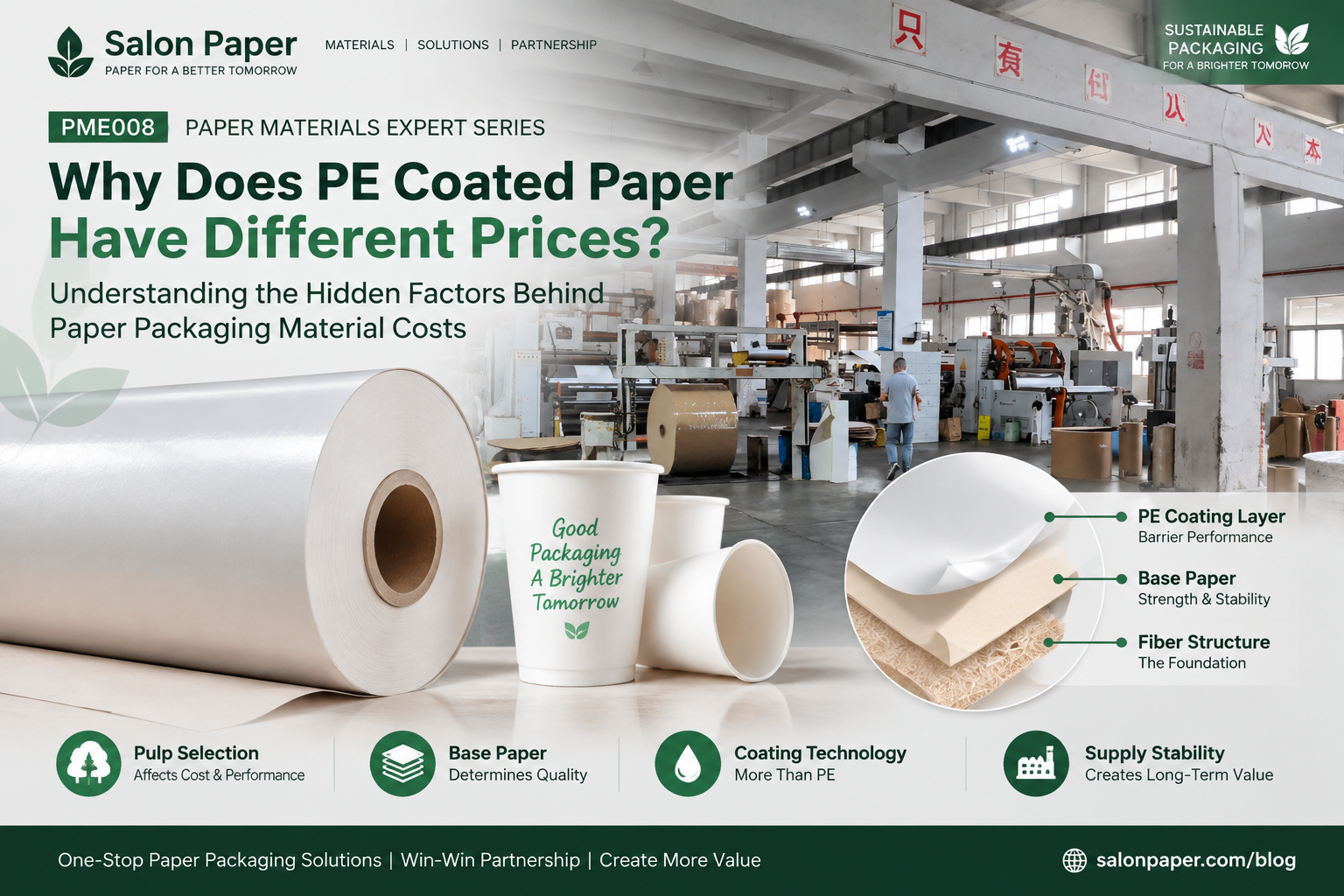
PE coated paper is a multi-layer material. Reading it from the outside in:
The coating provides the barrier. The base paper, however, decides whether the finished cup holds its shape, survives the printing press and folds without cracking. Base paper determines:
- Strength and stiffness
- Folding and creasing resistance
- Printing surface smoothness
- Processing stability on high-speed lines
At Salon Paper we select the base paper structure according to the customer’s application rather than applying one standard sheet to every market. Our commonly used pulp structures combine mechanical pulp, hardwood pulp and softwood pulp within a virgin wood pulp structure, so that bulk, stiffness and printability are balanced for the intended cup, bowl or food container.
3. Fibre Selection Influences Cost and Performance
Different fibres create different paper characteristics — and different costs. There is no universally best fibre; there is only the right fibre for the application.
| Pulp type | Main advantage | Typical role in the sheet |
|---|---|---|
| Hardwood pulp | Smooth surface, good printing performance | Surface quality and print detail |
| Softwood pulp | Longer fibres, higher strength | Stiffness and strength of the board |
| Mechanical pulp | Cost efficiency, good bulk properties | Bulk and thickness at controlled cost |
Paper cost is therefore not simply weight times price. It reflects fibre value, performance requirements and application needs together. A buyer who only compares the price per ton is comparing one variable out of five.
4. Coating Technology Is More Than PE
Many buyers focus on a single question: how much PE coating is applied? That matters, but it is not the whole picture — and modern food packaging increasingly requires alternatives to PE altogether.
PE coating
The workhorse for paper cups and food packaging applications. Available as single-side PE coating and double-side PE coating depending on the barrier and sealing requirement. Typical PE coating weight is around 18gsm, and maximum production width is up to 1400mm.
PLA coating
For customers moving toward renewable, bio-based material solutions while keeping a sealed, liquid-resistant surface. See our comparison of PLA vs PE coating and PLA vs PHA.
Water-based coatings
Including acrylic and EAA systems, providing alternative barrier solutions for markets where recyclability and repulpability requirements are tightening. Our overview of barrier coating technologies covers how these systems behave in practice.
Every coating choice changes cost — in the material itself, in the process, and in the compliance work that sits behind it. Two quotations that both say PE coated may still differ in coating weight, resin grade, adhesion system and width capability.
5. The Cheapest Material Is Not Always the Lowest Cost
For a paper cup manufacturer, material quality feeds directly into production efficiency. A stable, consistent material helps reduce:
- Production interruptions and unplanned machine stops
- Material waste from rejects and reels that cannot be used
- Quality problems that only appear after printing or forming
The real purchasing cost of PE coated paper should therefore include material price, production efficiency, quality stability and supply reliability. A material that costs 5% less per ton but raises the reject rate by 8% is the more expensive material.
6. Supply Capability Creates Long-Term Value
For global packaging buyers, reliable supply is as important as price. A quotation is only useful if the tonnage can actually be produced, packed and shipped on schedule. Our coating, laminating and converting operation works with a monthly base paper consumption of around 3,000 tons.
| Supply capability | What it covers |
|---|---|
| 3,000 tons of base paper consumed per month | Coating, laminating and converting capacity behind PE coated paper supply |
| Regular warehouse stock | Base paper and coated material held for recurring programmes |
| In-house processing | PE / PLA coating, laminating, metallizing, slitting and paper cup converting |
Salon Paper works mainly with paper cup manufacturers and packaging converters in Europe and North America, where documentation, consistency and delivery reliability carry more weight than a one-time price advantage.
7. From Price Competition to Value Creation
The purchasing logic of paper packaging is changing. With growing attention to sustainable packaging, material transparency, regulatory requirements and supply chain management, buyers are no longer only looking for the lowest price. They need partners who understand materials, applications, production requirements and market trends — and who can explain what is actually inside the sheet.
A supplier who can answer which pulp structure is in this board, and why, is usually the supplier who can also hold a specification stable for years.
How to Compare PE Coated Paper Quotations
When you receive several offers, these five questions separate a lower price from a lower cost:
- What is the base paper structure? Ask for fibre composition, not only GSM and bulk.
- What is the exact coating specification? PE grade, coating weight per side, single or double coating.
- Which converting machine will run it? Ask for samples matched to your cup forming line.
- What is the reference tonnage and lead time? Confirm the current supply capability, not a catalogue claim.
- What documentation comes with it? Material declarations, food contact and test reports with a clear scope.
Salon Paper Perspective
At Salon Paper we believe packaging material sourcing is not only about finding the lowest price. Our goal is to provide one-stop paper packaging solutions, build win-win partnerships and create more value for our customers. We support partners through professional material selection, stable supply, technical communication and packaging solution optimisation — so that the material specification holds up in production, not only in the quotation.
Need to compare PE coated paper specifications?
Tell us your cup size, GSM and coating requirement — we will send matched samples and a specification sheet so you can test the material on your own line.
Frequently Asked Questions
Why does PE coated paper price vary between suppliers?
Because the cost depends on pulp structure, base paper quality, coating technology and supply stability. Two suppliers can quote different prices for the same GSM and coating type because the fibre blend, board formation and coating consistency behind the material are not the same.
Is higher GSM always better for PE coated paper?
No. Paper performance depends on fibre structure and application requirements, not on weight alone. A well-formed lower-GSM cupstock can form, print and run better than a heavier board with a weaker fibre structure.
What coatings are available besides PE?
Common alternatives include PLA coating and water-based barrier coatings such as acrylic and EAA systems. Each option has a different cost, barrier profile and end-of-life performance, so the right choice depends on the food contact and recycling requirements of the finished packaging.
How should buyers compare PE coated paper suppliers?
Compare material quality, production capability, technical support and supply reliability - not only the quoted price per ton. Request samples from the same base paper structure, run them on your own cup forming machines, and ask for material declarations with a clear testing scope.