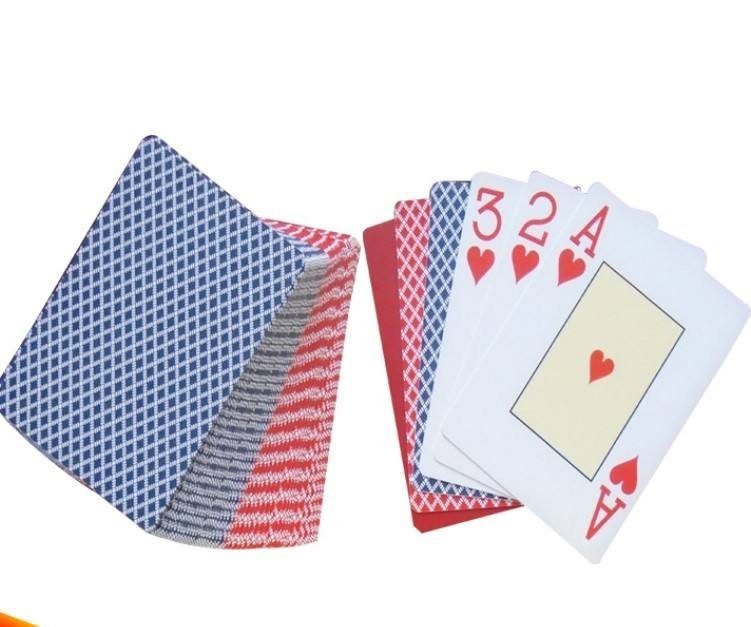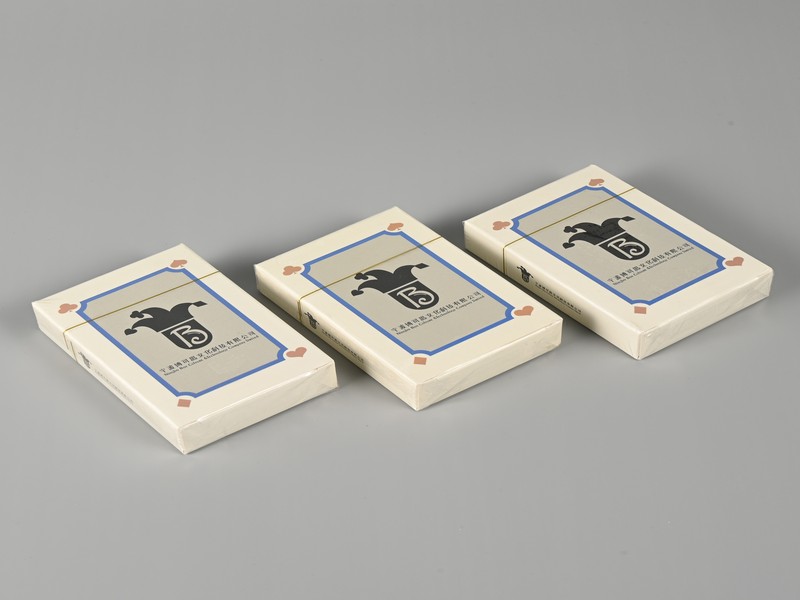
A playing card, a collectible trading card and a board game card may look like neighbours in the same paper category. In production, they are three different performance problems. One must hide its face from the back, one must reproduce fine artwork and survive handling as a collectible, and one must remain readable and affordable across tens of thousands of copies.
This PME guide compares the material priorities behind all three formats. It also explains when a lower-cost ivory board option can work for entry-level cards, and when it cannot replace a dedicated playing card paper.
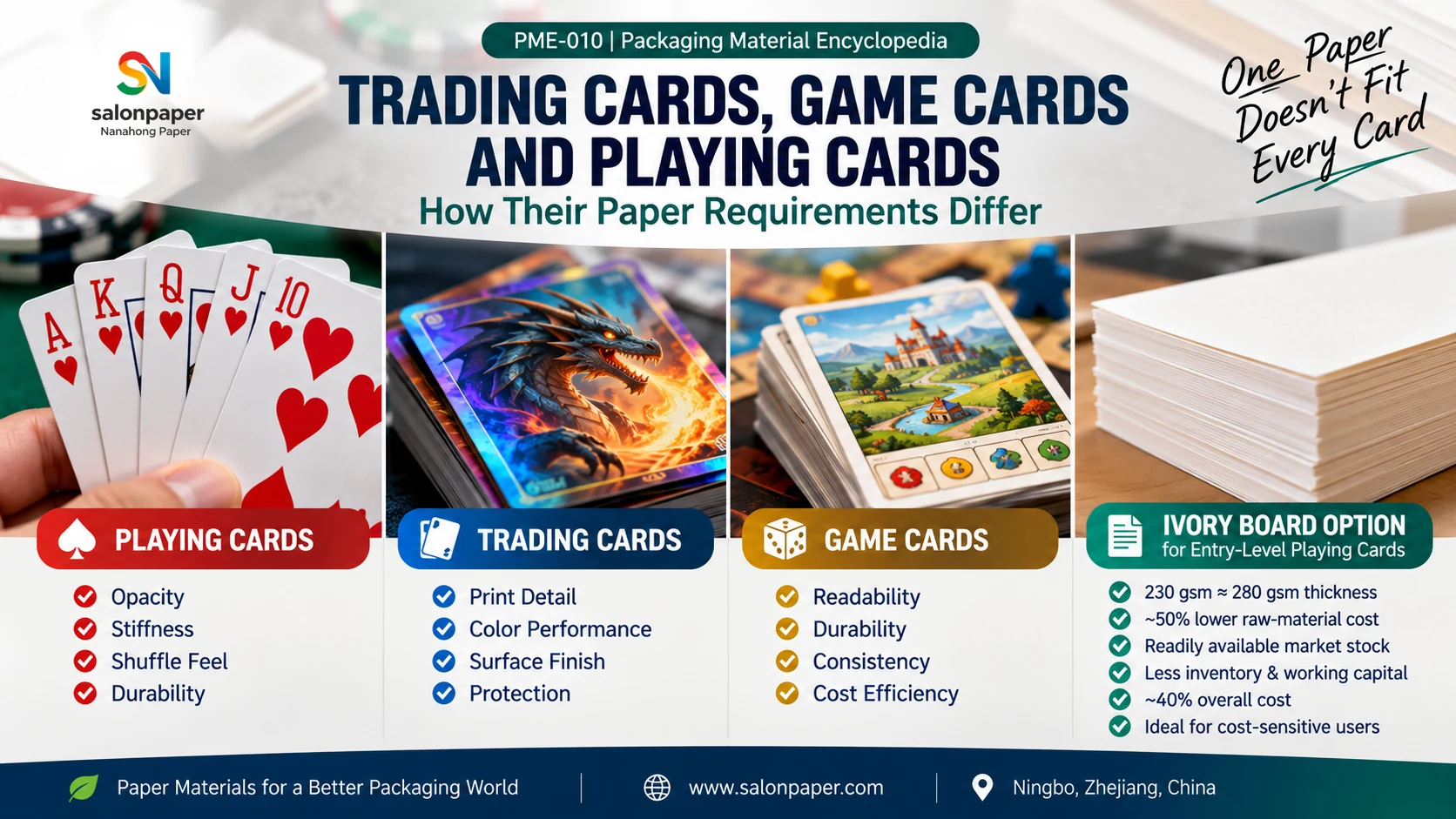
Quick Comparison: What Each Card Type Really Needs
The fastest way to specify card paper is to start from the end use, not from a familiar GSM number. The same grammage can perform very differently when the fibre structure, core, coating and surface treatment change.
| Card type | Primary material targets | What the end user notices | Typical construction or grade |
|---|---|---|---|
| Playing cards | Opacity, stiffness, snap, folding endurance | Shuffle feel, edge quality, no show-through | PC3-PC5 card board; black, blue or purple core |
| Trading cards | Print detail, colour, smoothness, surface protection | Sharp artwork, foil or holo effects, clean corners | Coated card board, often with a special core and finish |
| Game cards | Readability, durability, consistency, cost efficiency | Clear icons and text, repeatable play, stable supply | Blue, purple or economy core; 250-350 gsm range |
| Entry-level cards | Caliper, printability, stiffness-to-cost balance | Acceptable feel at a competitive price | 230 gsm ivory board can substitute for some heavier grades |
1. Playing Cards: Opacity, Stiffness and Shuffle Feel
A playing card is a handling product before it is a printed product. The user feels the deck immediately: the initial snap, the consistency of the edges, the friction during a riffle shuffle and whether the cards remain flat after repeated play.
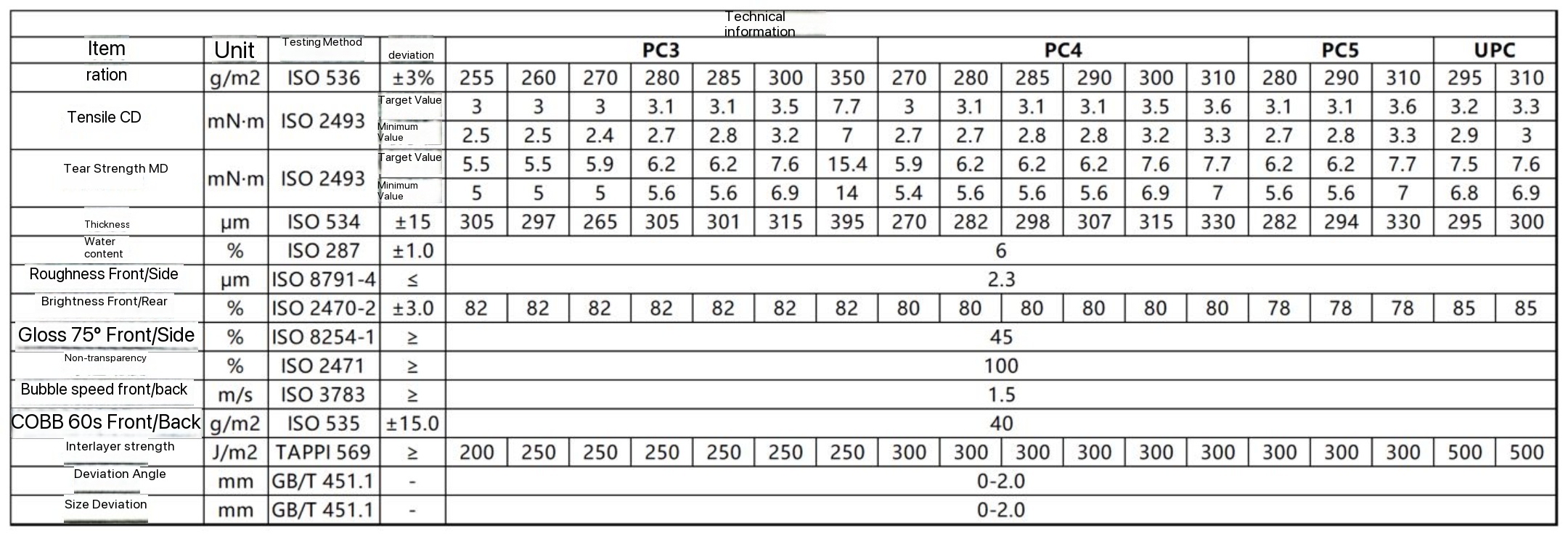
Professional playing card paper typically falls in the 255-350 gsm range. PC3, PC4 and PC5 describe increasing grades of stiffness, formation, surface quality and batch consistency. The core matters as much as the total weight: black core supports premium opacity and a crisp edge, blue core is common for durable standard and premium decks, and purple core offers a lower-cost route for promotional or educational cards.
For standard decks, ask for measured stiffness in both machine and cross directions, opacity of at least 92% for the selected construction, controlled moisture, good internal bond and a smooth surface that accepts offset or digital print without picking.
- Test the finished card, not only the paper sheet: snap, bend recovery, edge cut and shuffle friction all depend on construction.
- Check opacity against the actual print coverage; a dark back design exposes weaknesses that a blank sample hides.
- Keep caliper and moisture tolerances tight enough to avoid uneven decks after cutting and packing.
2. Trading Cards: Print Detail, Colour and Surface Protection
Collectible trading cards are closer to premium print products. The buyer judges the card front under strong light: fine linework, smooth colour transitions, clean whites, sharp foil edges and a surface that resists scuffing during handling and sleeving.
The base sheet therefore needs high smoothness, stable formation and predictable ink holdout. A coated surface is usually required, while the reverse side may need a different finish for text, rules or branding. When the design uses holographic paper, metallic board or foil stamping, the paper must also tolerate heat, pressure and multiple print passes without curling or losing dimensional stability.
Trading cards also place more emphasis on protection. The surface finish is not only decorative: it controls gloss, friction, fingerprint visibility and resistance to abrasion. Specify the finish together with the paper, because a coating that looks correct can still block, crack or change colour after cutting and packing.
- Approve proofs on the actual coated stock; colour on a generic art paper is not a reliable guide.
- Test ink adhesion, foil adhesion and score-line cracking before a production run.
- Control curl and moisture after each print and finishing pass, especially for double-sided artwork.
3. Game Cards: Readability, Durability and Cost Consistency
Board game, educational and family cards have a different job. Players read icons, numbers and short rules across a table, so contrast and legibility can matter more than the last few percent of photographic colour accuracy. At the same time, a game may ship with several decks, tokens and a box, so material cost and repeatability become central.
Blue-core and purple-core card boards are common choices in this segment. The objective is to find a grade with enough stiffness and opacity for the intended play pattern without overspecifying the deck. For light-use promo cards or a single-print educational product, a lower-cost construction can be appropriate; for a game expected to survive hundreds of sessions, folding endurance and surface durability should not be compromised.
Consistency is a purchasing issue as much as a technical one. Multi-deck games need cards from different production batches to feel the same in the hand and shuffle the same way. Ask suppliers how they control grammage, caliper, moisture and surface friction between runs.
- Match card thickness to the age group and play style; very thick cards are not automatically better for family games.
- Use a readable coated surface with controlled gloss to avoid glare under indoor lighting.
- Lock a reference sample and tolerances before scaling to multiple decks or reprints.
4. When Ivory Board Makes Sense for Entry-Level Cards
A 230 gsm ivory board can sometimes deliver a caliper close to a heavier coated card because bulk, density and coating differ between grades. That can reduce material usage and improve availability for entry-level playing cards, promotional decks, educational cards and simple family games.
The saving is not automatic. A lower-cost ivory board may have different stiffness, opacity, surface strength and moisture behaviour. It may print well but feel soft after repeated shuffling, or look opaque in a sample and show through after heavy ink coverage. The only reliable comparison is a finished-card trial using the intended print, coating, cutting and packing process.
Use ivory board as a value-engineering option, not as a blind substitute. Benchmark measured caliper, stiffness, opacity, ink adhesion and shuffle durability against the original grade. Then compare total landed cost, including yield, waste, freight and the risk of customer returns.
- Suitable candidates: promotional decks, simple educational cards, low-cost family games and short-life giveaways.
- Usually unsuitable: casino decks, premium collectible cards, heavy-use tournament cards and products where show-through is unacceptable.
- Validate the economics on finished cards per tonne and per deck, not on paper price per tonne alone.
How to Specify the Right Card Paper
A practical specification should describe the finished card, the printing route and the market expectation. Use this sequence when comparing suppliers:
- Define the card type and expected use: casino play, collectible, family game, promotion or education.
- Set measurable targets for grammage, caliper, MD/CD stiffness, opacity, brightness, gloss or roughness, moisture and curl.
- Confirm the core type, coating and surface finish, including any foil, holographic or special barrier requirement.
- Run the intended print and finishing process on sample sheets, then test cutting, shuffling, scratching and humidity resistance.
- Approve a retained reference sample and batch tolerances before repeating the order.
- Compare suppliers on consistent availability, documentation and technical support, not on one low quotation.
Quality Checks Before Bulk Approval
| Check | What to verify |
|---|---|
| Opacity | No show-through under the final print and lighting condition. |
| Stiffness | Measured in MD and CD; consistent snap after cutting. |
| Caliper and moisture | Stable decks, clean registration and predictable forming. |
| Surface | No picking, blocking, scuffing or patchy coating. |
| Converting | Clean edges, no score cracking and stable stacking. |
Salon Paper Perspective
Salon Paper supplies specialty paper and paperboard for card, packaging and converting applications, including playing card paper, ivory board, metallic board and holographic paper. The right choice is not the heaviest sheet or the lowest price; it is the construction that meets the handling, print and cost targets of the finished card.
Send us the card format, target market, printing method, estimated quantity and required performance. We can compare suitable grades, prepare samples and help you test the material through your own converting line.
Need Help Choosing Card Paper? Tell us whether you are producing playing cards, trading cards or game cards, and we will recommend a practical starting specification.