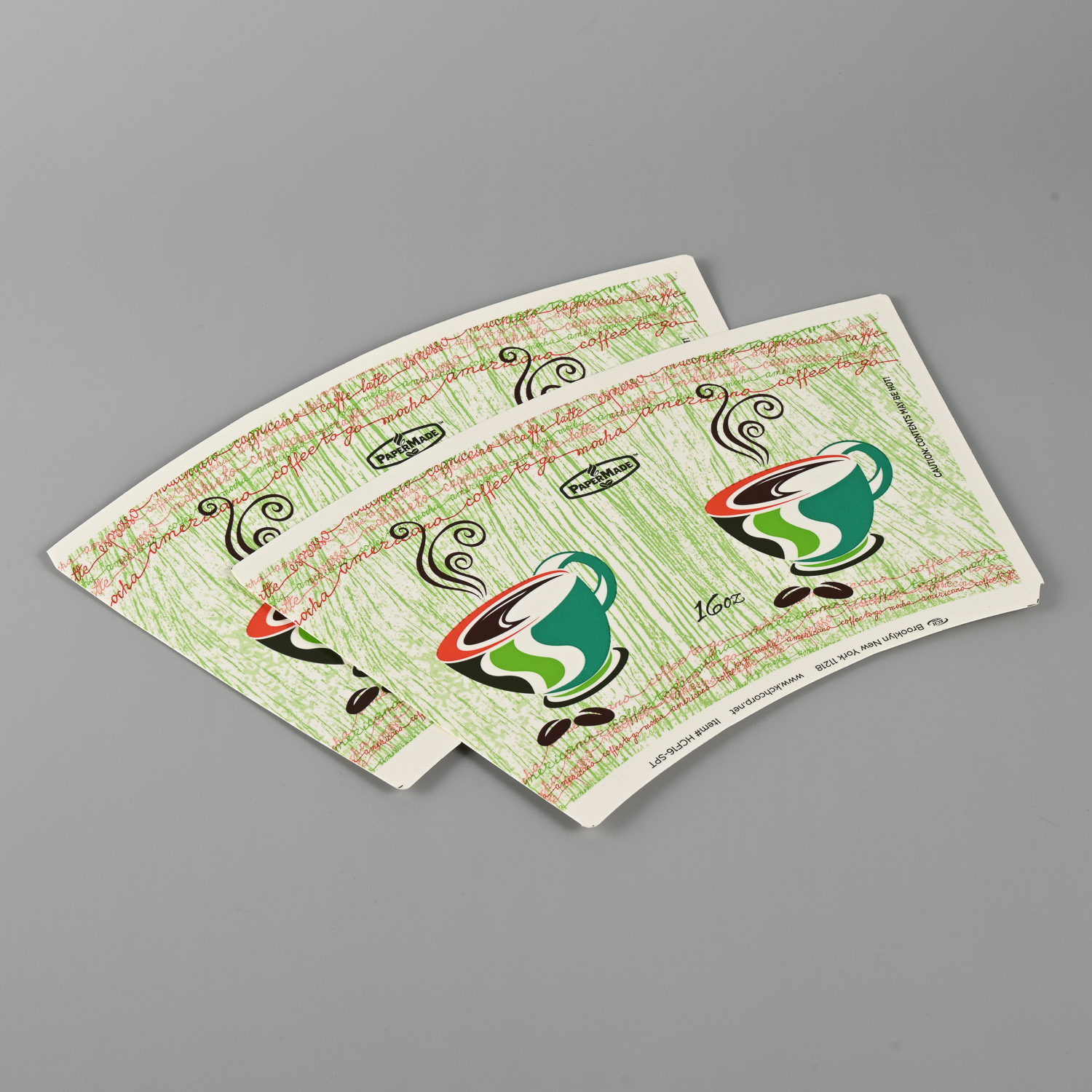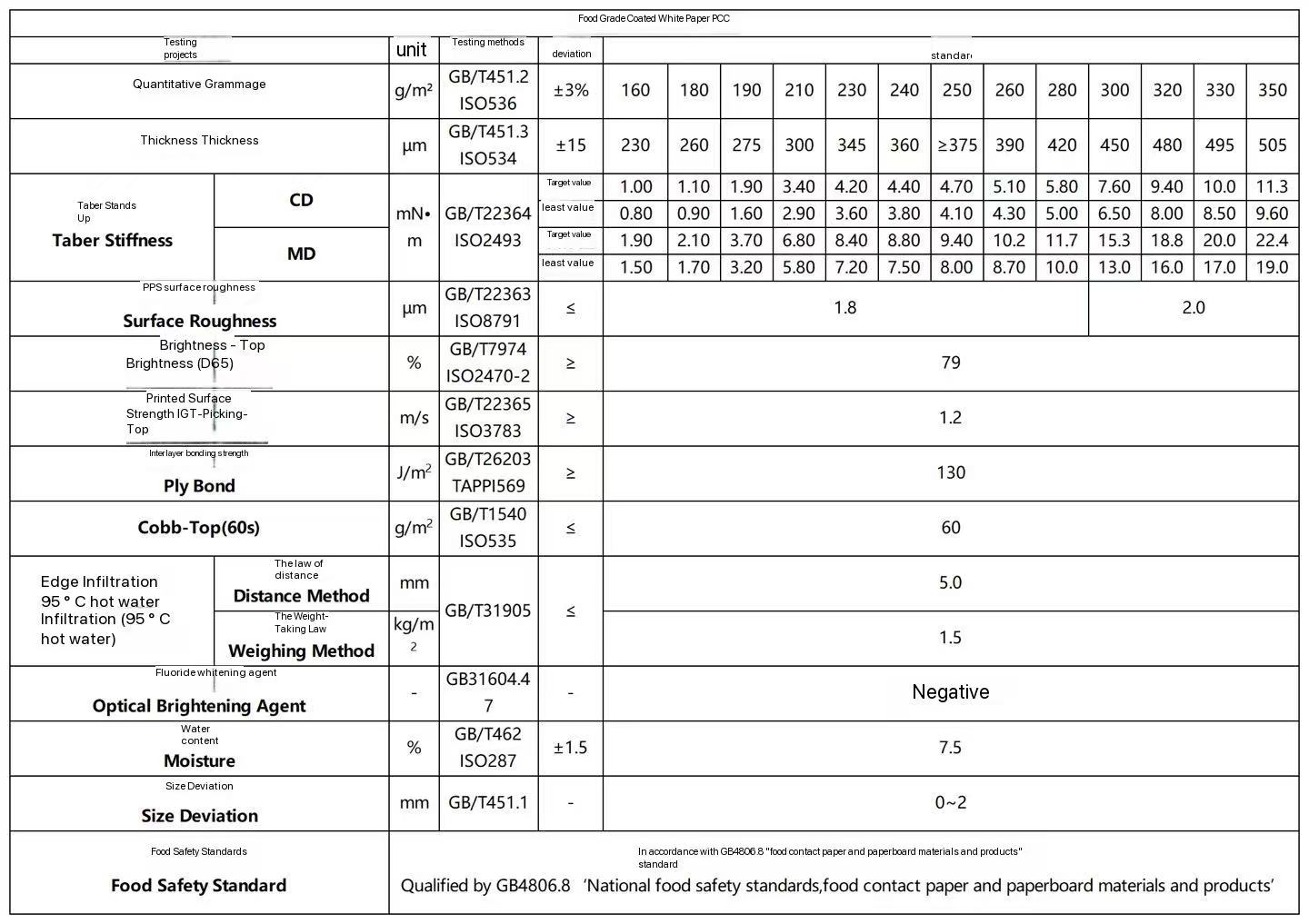
A paper cup is often judged on the finished shelf, but most quality problems begin earlier: at the material, coating and flat-blank stage. A roll of cupstock can meet its nominal grammage and still form poorly if the coating is uneven, the grain direction is wrong, the die outline does not suit the machine or the cut edge releases dust.
This PME guide follows the practical route from food-grade cupstock to PE-coated paper cup fan blanks. It explains what each process step controls, which material data buyers should confirm and how to reduce avoidable loss during cup forming.
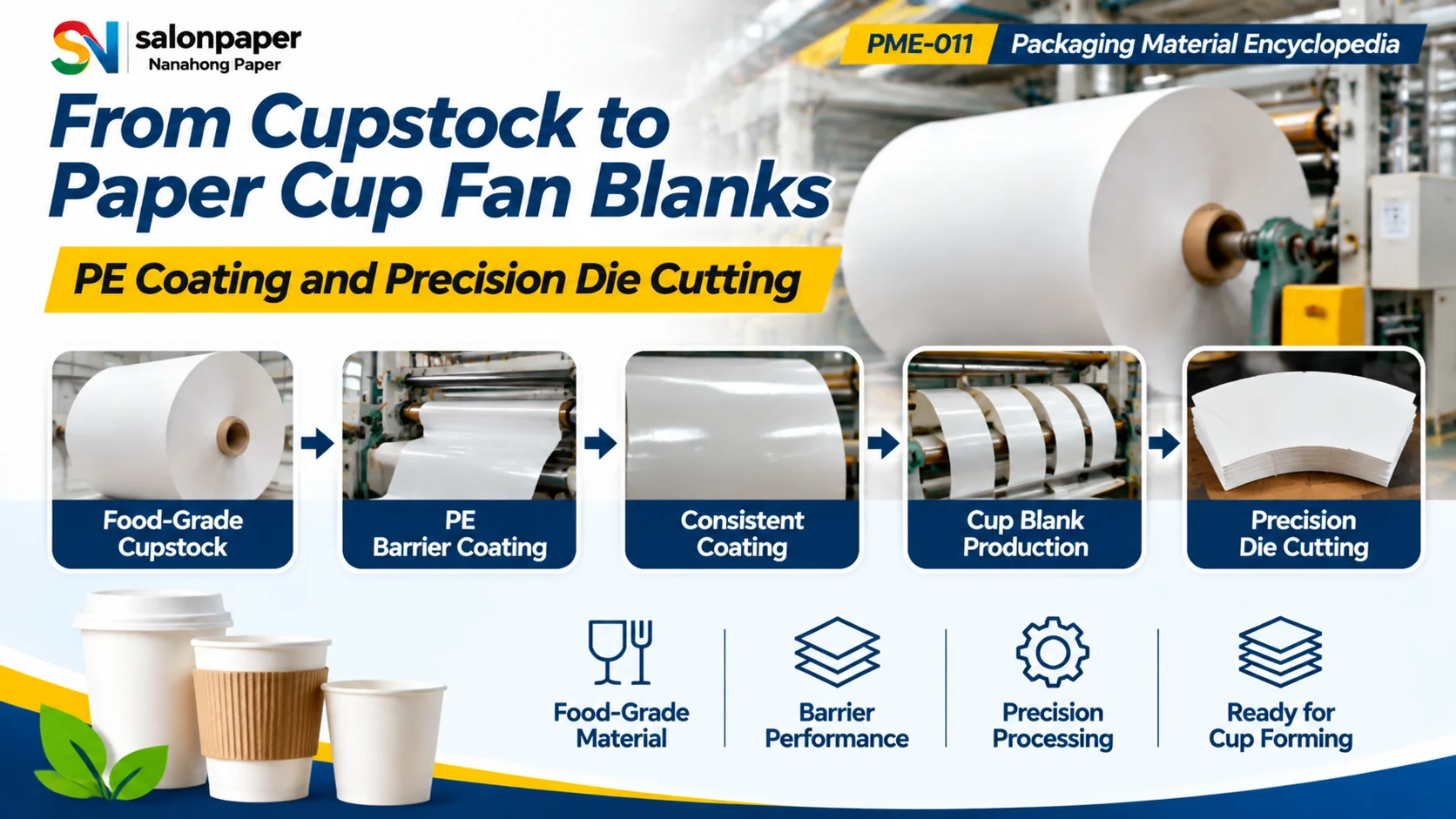
Watch the 50-Second Factory Process
See the real production route from food-grade cupstock through PE coating and precision die cutting to finished paper cup fan blanks.
The Five-Stage Process at a Glance
| Stage | What happens | What it controls | Buyer check |
|---|---|---|---|
| 1. Food-grade cupstock | Select board for stiffness, formation and food-contact suitability. | Cup strength, surface, caliper and print base. | Grade, grammage, caliper, moisture and documentation. |
| 2. PE barrier coating | Apply and bond a polyethylene layer to the required side. | Liquid barrier, sealability and surface continuity. | Coating type, weight, side and adhesion. |
| 3. Consistent coating | Control thickness, drying and winding across the web. | Stable heat sealing, fewer pinholes and less curl. | Coating profile, visual defects and roll condition. |
| 4. Cup blank production | Print, slit and prepare the correct web for each cup size. | Registration, roll width, grain direction and print quality. | Artwork, repeat, roll direction and print approval. |
| 5. Precision die cutting | Die-cut the fan shape to the approved machine drawing. | Forming fit, overlap, stacking and material yield. | Die outline, fan dimensions, edges and count. |
1. Food-Grade Cupstock: Start With the Forming Requirement
Cupstock is not chosen by grammage alone. The forming machine applies heat, pressure and mechanical deformation to the blank. A sheet that feels stiff in a sample book may still crack at the seal seam, curl after printing or collapse when the cup is filled if its caliper, moisture and fibre formation do not suit the application.
Define the cup size, hot or cold use, expected service life, print coverage and food-contact requirements first. Then compare measurable material properties: grammage, caliper, stiffness, brightness, smoothness, moisture, dimensional stability and lot-to-lot consistency. Food-contact compliance must be supported by the correct documentation for the actual grade and destination market; a generic certificate is not enough.
- Confirm whether the cup needs one-side or two-side PE coating.
- Check that the specified board can accept the intended print and varnish system.
- Approve a retained sample before repeating a production grade.
- Keep paper, coating and finished cup specifications linked to the same approval record.
2. PE Barrier Coating: Barrier and Sealability Together
PE coating provides a liquid barrier and creates a heat-sealable surface. Its performance is not determined by coating weight alone. Adhesion, continuity, pinholes, oxidation state, cooling and winding tension all affect how the coated sheet behaves in the cup machine.
The coated side must match the cup-forming design. The overlap seam, bottom seal and any inner-surface requirement need to be known before coating. A heavier coating is not automatically better: excess coating can increase cost, affect cutting, change seal response and create unwanted curl, while an under-coated area may leak or fail after forming.
3. Consistent Coating: The Hidden Source of Forming Loss
“Consistent coating” means more than an average coating weight printed on a test report. The buyer needs confidence that the coating is continuous across the web, stable from edge to edge and repeatable between rolls. Local thin spots can become pinholes; heavy bands can cause blocking, curl or uneven heat transfer.
Ask how the supplier controls coating weight, drying, web tension, surface defects and roll splicing. Visual inspection should be paired with the converter’s own seal and leak tests. If a defect appears only after forming, the coating and machine parameters need to be investigated together rather than treated as separate problems.
- Inspect both the coated surface and the cut edge.
- Check for streaks, pinholes, gels, scratches and uncoated patches.
- Record the coating side on every roll and packing label.
- Keep roll splices and damaged sections out of critical forming areas.
4. Cup Blank Production: Match Print, Grain and Roll Width
For printed cups, the blank begins as a controlled web. Print registration, ink adhesion, surface friction and the repeat length must work with the die layout. The grain direction also matters: it affects stiffness around the finished cup, the way the fan curls and the reliability of the side seam.
Roll width should be planned for the chosen fan layout, not selected independently. A small mismatch can increase edge trim and reduce yield across thousands of pieces. For multi-colour designs, approve the artwork and colour on the actual coated stock and check that the coated side and print sequence match the intended cup surface.
- Lock the die drawing, cup size and machine model before ordering printed rolls.
- Confirm artwork orientation and seam position on a production blank.
- Inspect print registration, scuffing and blocking after rewinding.
- Calculate yield from the actual nested fan layout, not from sheet area alone.
5. Precision Die Cutting: Fit Before Speed
The fan blank is a precision component. Its arc lengths, side angles, corner radius, height and overlap allowance determine whether the cup forms round, seals without gaps and stacks correctly. A die that is visually similar is not necessarily interchangeable with the approved drawing.
Edge quality is equally important. A clean cut reduces dust and fibre tear, protects the coating near the seam and helps the blank feed reliably. Operators should check die wear, cutting pressure, anvil condition and the condition of the cutting rule, then verify the first-off pieces against the approved template.
- Approve the first-off fan against the die drawing and a formed cup.
- Monitor dimensional drift as the die wears.
- Check dust, edge cracking and coating damage at the seam area.
- Pack blanks in a way that prevents curl, compression and moisture pickup.
Specification Sheet: What to Confirm Before Ordering
| Item | Why it matters |
|---|---|
| Cup size and purpose | Determines blank geometry, stiffness and barrier needs. |
| Board grade | Links forming behavior, printability and food-contact documentation. |
| Grammage and caliper | Must be checked together; one value does not define stiffness or feel. |
| Coating type and side | Controls barrier, seal orientation and cup-machine setup. |
| Coating weight and tolerance | Needs a defined test method and agreed acceptance range. |
| Die drawing | Defines fan dimensions, overlap and machine fit. |
| Grain direction | Affects curving, stiffness and side-seam behavior. |
| Print and food-contact requirements | Must match the destination market and actual end use. |
| Packing and moisture protection | Prevents curl, blocked sheets and count errors before forming. |
Incoming and First-Off Quality Checks
Use a two-level inspection plan: verify the delivered material, then verify the blank at the forming line. This separates supplier variation from machine-setting problems and gives both sides a common record for corrective action.
- Incoming: roll identity, grade, coating side, width, splice count, moisture, visible defects and packing condition.
- Before die cutting: print registration, surface condition, web tension and correct roll orientation.
- First-off blank: die dimensions, fan symmetry, edges, dust, coating at the seam and stacking behavior.
- Formed-cup trial: seam strength, bottom seal, roundness, leakage and appearance under the intended use condition.
- Retained samples: keep approved material, blank and finished cup references for future batches and complaints.
Salon Paper Perspective
Salon Paper supports paper packaging buyers with cupstock, PE-coated paper and converting requirements. The most useful starting point is not a single price per tonne; it is the complete material and blank specification tied to the cup machine, print route and destination market.
Send the cup size, target quantity, board grade, coating requirement, die drawing, machine model and required documentation. We can help compare practical material options, prepare samples and review the information needed for a stable cup-forming trial.
Need help specifying cupstock or paper cup fan blanks? Share your cup format and machine details so the material, coating and die dimensions can be checked together.